Texas Southern President Highlights Student Success, Research Growth and Campus Investments Ahead of Centennial
 Texas Southern University is advancing student success, expanding its research enterprise and moving forward with major campus improvements as it prepares to celebrate its Centennial in 2027.
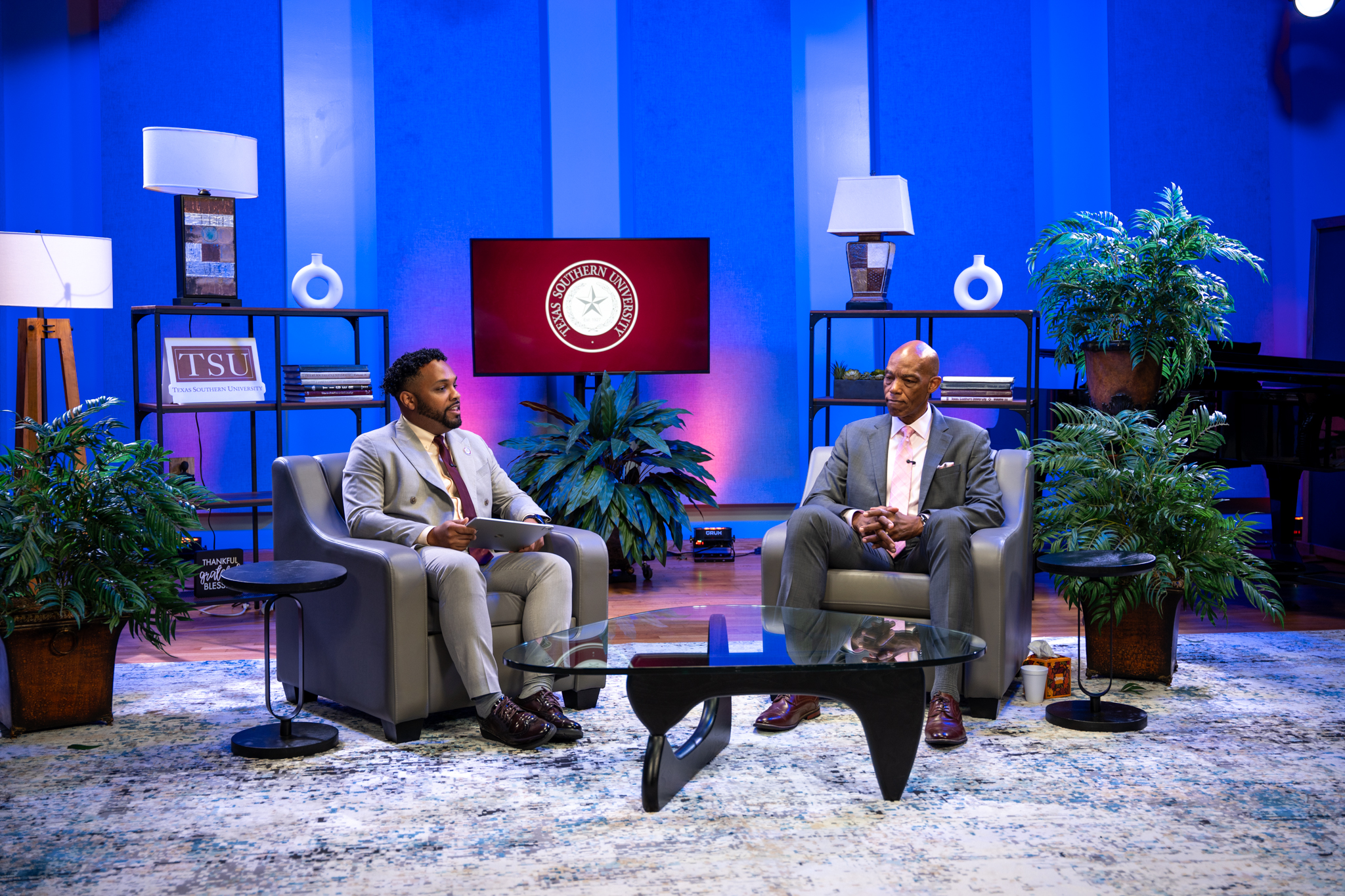
In a recent conversation with KTSU 90.9 FM, President J.W. Crawford III reflected on the University’s progress and the work ahead during The State of Texas Southern University: A Presidential Conversation, recorded and broadcast on October 23.
Hosted by Charlie W. Coleman III, senior associate vice president of University Advancement, the conversation highlighted improvements in student persistence and progression, $55.1 million in research awards secured in fiscal year 2026, and construction underway on three major campus facilities.
Crawford framed the University’s next chapter as both a continuation of its legacy and a responsibility to prepare for the future. “You fail in a journey of reimagination if you become disconnected from your history,” he said, emphasizing the importance of building on the achievements of generations of students, alumni, faculty and staff while positioning Texas Southern for its second century.
Student success remains the central priority
Crawford reflected on his decision to lead Texas Southern and the responsibility universities have to help students navigate the path from enrollment to graduation.
“When I saw Texas Southern University and had the opportunity to come here, the first thing that drew my attention were these students because they are me,” Crawford said, describing how his own experience finding a path to higher education shaped his commitment to student opportunity.
The University is reporting improvement in two important measures of student success. Persistence increased from 66.2% in academic year 2023–24 to 70.2% in 2024–25, while progression rose from 27% to 35% over the same period.
Crawford attributed the progress in part to additional academic coaches and advisors and access to tutoring around the clock. He said the University must continue identifying barriers, connecting students with support and keeping progress toward graduation at the center of its work.
During Homecoming week, Texas Southern recognized 547 students at its Tiger Stripes ceremony for completing 30 credit hours and advancing from freshman to sophomore standing. More than 2,800 students were also recognized through the Rush the Field academic recognition initiative.
The initiatives make academic achievement visible and reinforce a campus culture in which progress toward a degree is a shared priority.
Campus Master Plan moves from vision to construction
Crawford outlined progress under the University’s approximately $1.7 billion Campus Master Plan, a 10-year framework encompassing more than 20 phased projects to modernize facilities, support research and wellness, enhance the student experience and strengthen connections with the surrounding community.
In September, Texas Southern broke ground on three projects: the Catalyst for Urban Transformation, the Health and Wellness Center, and the Nabrit Science Center. Together, the projects represent more than $95 million in state-supported capital construction, with openings anticipated during the University’s Centennial year in 2027.
The broader revitalization effort includes renovations to Reinhardt Auditorium and the Banks Building, now home to the Center for Urban Transformation, as well as the removal of aging facilities, including the former Terry Library and original Nabrit Science Building.
Crawford also discussed planning for a proposed Thurgood Marshall Law Center and the need for a dedicated practice facility for the Ocean of Soul Marching Band.
The Campus Master Plan supports Ascend 2030, the University’s strategic plan, organized around four pillars: student achievement and outcomes; academic research and innovation; operational excellence; and technology and artificial intelligence.
For Crawford, the investments are about more than buildings. They are about creating spaces that support learning, research and a stronger student experience.
“We’ve begun a very aggressive revitalization program,” Crawford said.
Stronger operations support institutional progress
Crawford emphasized that academic ambitions and campus investments depend on effective leadership, reliable systems and responsible stewardship of University resources.
Texas Southern has established its first chief administrative officer position, strengthened its financial leadership and continued filling dean positions across its schools and colleges. Crawford said he expects every school and college to have a permanent dean by February 2027.
He also cited the University’s aviation program as an example of how performance can help attract investment. When he arrived, the program had 10 aircraft, some more than 40 years old. With $5 million in state funding and additional contributions from donors, the program now has a 13-aircraft training fleet and no debt.
Crawford also addressed plans for a football stadium on campus and the need to play games at other venues during the transition. He said the long-term goal is to create a more complete on-campus experience for students, alumni, fans and supporters.
Pointing to the new academic and research facilities, Crawford underscored his commitment to delivering on the University’s plans.
“We do what you say. And we’re doing what we said,” Crawford said.
Research growth advances discovery and community impact
Texas Southern holds Carnegie R2 research status and the Carnegie Community Engagement Classification and is working to strengthen its research enterprise as it pursues R1 research status.
Crawford emphasized that the pursuit is about more than earning a designation. It is about improving the academic experience, expanding opportunities for students and increasing the University’s ability to address challenges facing Houston and other communities.
“That’s not about pinning a medal on the institution,” Crawford said. “That’s about improving what we do for our students.”
The Division of Research and Innovation secured $55.1 million in research awards in fiscal year 2026, a 72% increase over the previous year. A renewed five-year, $21.5 million National Institutes of Health grant and a $9.9 million Department of Defense grant are among the FY26 grants.
As of October 19, the University had submitted 26 research proposals totaling $14.7 million and received 23 external federal grants totaling $23.3 million for fiscal year 2027.
Research at Texas Southern spans biomedical health, public policy, urban planning, criminal justice, high performance computing, transportation and emerging technologies. Crawford highlighted the University’s Breast Cancer Center for Research and Prevention, led by Dr. Ajewale, which secured a $2 million grant supporting breast cancer screening and prevention. He also pointed to federal support for advanced materials research through the Department of Energy’s National Nuclear Security Administration.
The work reflects Texas Southern’s role in preparing students, advancing discovery and contributing to the needs of Houston and communities beyond.
Graduates and alumni strengthen the regional economy
Crawford said the University’s responsibility extends beyond graduation to helping students prepare for careers, contribute to their communities and create opportunities for others.
During Fall 2024 to Spring 2025, there were 1,615 graduates and this increased to 1,718, the following year which represents a 6% increase. In Spring 2026, 1,093 graduates represented the largest graduating class in the University’s history.
Crawford said Texas Southern will continue strengthening pathways from academic preparation to employment and career advancement, including additional investment in the University’s Career Pathways program.
“We’re not here to direct their futures,” Crawford said. “We’re here to help guide their futures. They create their own futures. We help them shape what that looks like.”
The University’s economic impact report found that Texas Southern generates approximately $1.6 billion in annual economic impact and supports 15,676 jobs. Crawford noted that alumni contribute to this impact through their professional accomplishments, entrepreneurship and the opportunities they create for others.
A Centennial grounded in history and focused on the future
Founded in 1927, Texas Southern has endured and responded to profound changes in American history, including the Great Depression, World War II, the Civil Rights Movement and the rise of the digital age. Crawford said that history provides both a foundation for the University’s next chapter and an obligation to build on the achievements of generations of students, alumni, faculty and staff.
The Centennial is an opportunity to celebrate that legacy while looking ahead. Through Ascend 2030 and its priorities to Renew, Enhance and Expand, the University is aligning its efforts around student achievement, research, campus development and institutional progress.
Crawford acknowledged that challenges remain and emphasized the importance of measuring progress through results and continued accountability. He encouraged alumni, students, supporters and the Houston community to stay engaged by mentoring students, supporting University programs, returning to campus and sharing the Texas Southern story.
“The best is yet to come,” Crawford said.
As Texas Southern approaches its second century, the University is building on its legacy of educational opportunity while pursuing stronger student outcomes, expanded research, modern facilities and a deeper contribution to Houston and beyond.